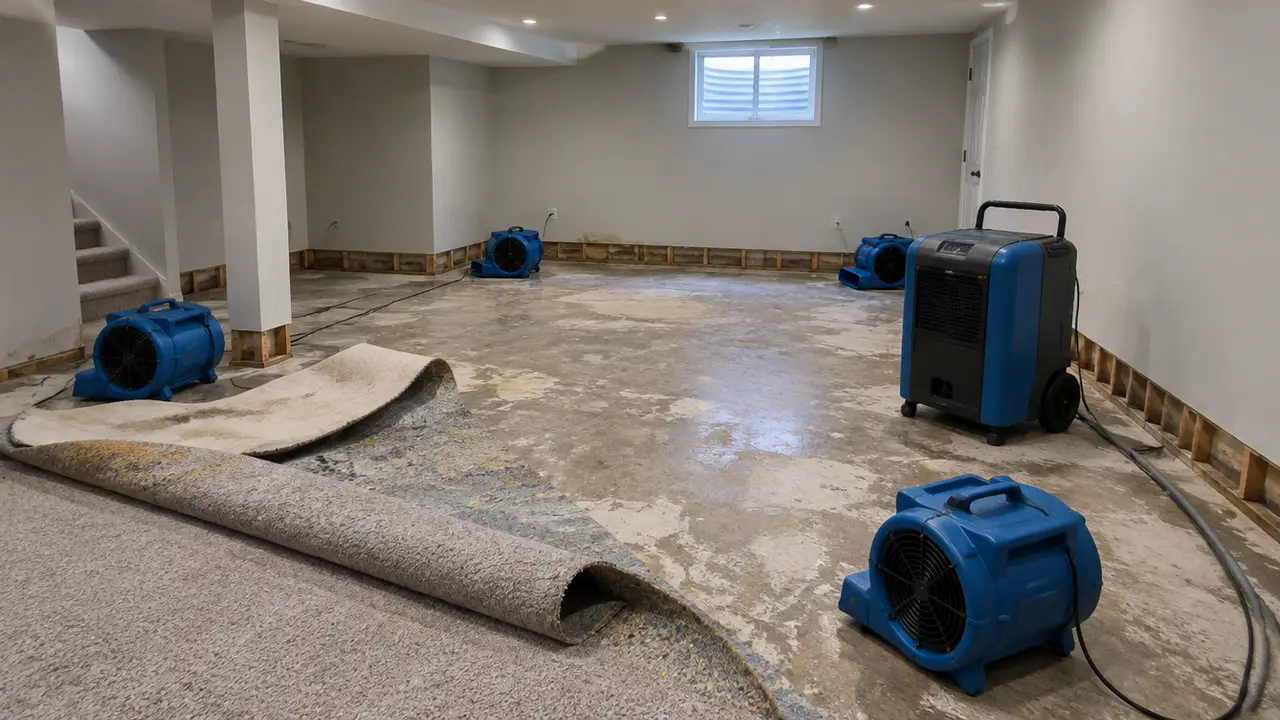
After a burst pipe, remove standing water the same day, pull out materials that hold water such as carpet pad, wet insulation and the lower part of soaked drywall, and run dehumidifiers and air movers until moisture readings return to normal. Health Canada says a house and furnishings are less likely to grow mould if dried within 48 hours, so the first two days decide most outcomes.
- Health Canada links a lower mould risk to drying within 48 hours; CMHC advises removing materials that cannot dry in that time.
- Drying is extraction, removal, air movement and dehumidification together; fans alone move damp air around.
- Moisture readings, not touch or appearance, decide when framing and subfloor are dry.
- Keep indoor relative humidity between 30% and 50% once drying ends, as Health Canada recommends.
- Photograph every item before it goes in a bin, and keep samples of flooring and cabinetry for the adjuster.
01 /Why does the 48-hour window matter?
Because it is the practical line between drying a house and cleaning mould out of one. Health Canada's flood cleanup guidance says a house and its furnishings are less likely to grow mould if they are dried within 48 hours, and CMHC advises discarding materials that cannot be dried within that time. Mould needs moisture, a food source such as the paper face of drywall or wood, and time, and the first two days are when you control the moisture.
| Time after the burst | What is happening | What to be doing |
|---|---|---|
| First hour | Water spreads across floors and into wall bottoms and the floor below | Stop the water, extract, move contents |
| Hours 1 to 12 | Drywall wicks water upward; carpet pad and insulation saturate | Pull pad and wet insulation, start dehumidifiers |
| Hours 12 to 48 | Framing and subfloor absorb water; laminate edges swell | Cut drywall above the wet line, run air movers, take readings |
| After 48 hours | Wet cellulose materials at rising mould risk; odour may start | Remove what has not dried; keep equipment running and monitored |
| Days 3 to 7 | Structure dries toward normal if equipment is sized right | Log readings daily until they reach the dry baseline |
02 /What should be removed after a burst pipe?
Anything porous that is soaked and cannot be dried quickly and thoroughly. Health Canada lists insulation, drywall, carpets, particleboard furniture, mattresses, pillows and cushions among the materials exposed to flood water that should be discarded if they cannot be dried, and CMHC advises cutting wet drywall at least 30 cm above the flood water line. A clean-water supply burst caught fast gives you more room to save things than a flood does, but the principle is the same.
| Material | Usual decision | Notes |
|---|---|---|
| Concrete, tile, solid wood framing | Keep and dry | Dries well with air and dehumidification |
| Drywall wet only at the surface, dried within hours | Often kept | Confirm with readings; watch for staining and softness |
| Drywall soaked or wet more than a day | Cut out above the wet line | Standard practice is a clean horizontal cut |
| Batt insulation, cellulose | Remove | Holds water against framing |
| Carpet pad | Remove | Rarely dries in time; carpet itself may be saved if clean water and dried quickly |
| Laminate, vinyl plank with a fibre core, engineered wood | Often replaced | Swelling and cupping are usually permanent |
| Solid hardwood | Sometimes saved | Specialised floor drying; may cup and need refinishing |
| Particleboard cabinets and furniture | Often replaced | Swells and loses strength when wet |
| Mattresses, upholstered furniture, cushions | Often discarded if soaked | Hard to dry through |
03 /How does drying equipment work?
Air movers pull moisture out of wet surfaces into the air, and dehumidifiers pull it out of the air into a drain or tank. Used together, they keep evaporation high without letting the room's humidity climb. Fans alone raise humidity and can push moisture into dry areas.
| Equipment | Role | Practical note |
|---|---|---|
| Wet vacuum or extraction unit | Removes standing water and water held in carpet | The fastest way to cut drying time; extraction beats evaporation |
| Air movers | High-velocity air across wet surfaces | Aimed along walls and under opened cavities |
| Refrigerant dehumidifier | Condenses moisture out of warm air | Works best in a heated space |
| Desiccant dehumidifier | Absorbs moisture chemically; works in cool spaces | Common in cold basements and crawlspaces |
| Cavity drying systems | Push dry air into wall cavities through small holes | Can save drywall when used early |
| Moisture meters and hygrometers | Measure material moisture and air humidity | Tell you when drying is actually done |
Health Canada suggests opening windows and doors when the weather allows, using fans when outdoor air is dry and mild, and relying on dehumidifiers when outdoor conditions are not suitable. In a Canadian winter, outdoor air is usually cold and dry, which can help, but it also chills the house and slows evaporation; keep the heat on while drying.
04 /How do you know when everything is dry?
When moisture readings on wet materials match readings on the same materials in an unaffected part of the house. That comparison, called a dry standard or baseline, is how restoration crews decide to pull equipment, and it is the record an adjuster will ask for.
- Take a reading on dry drywall, framing and subfloor in an unaffected room. That is the baseline.
- Mark the wet areas and record readings at the same spots each day.
- Keep equipment running until the wet readings match the baseline.
- Check the air: indoor relative humidity should settle within the 30% to 50% range Health Canada recommends.
- Only then close walls, install flooring or put contents back.
A clean-water burst dealt with quickly often dries in several days, but the number depends on the materials, how much was removed, the equipment and the season. Ask for daily readings in writing if a company is doing the drying.
05 /Can you dry out a burst pipe yourself?
For a small, clean-water leak caught quickly on hard surfaces, often yes. For soaked walls, ceilings, carpet or anything that has been wet overnight, professional drying is usually worth it because the equipment and moisture meters are the difference between dry and looking dry.
If you are claiming, ask your insurer before choosing. IBC notes you can use a contractor of your choice, but the adjuster will expect the drying to be documented. Plumber or water damage restoration company? compares the roles.
06 /What if mould has already started?
Small areas can be cleaned by a careful owner; larger ones need professionals. Health Canada classes up to three patches, each smaller than 1 m², as small, patches of 1 to 3 m² or more than three patches as medium, and anything over 3 m² as extensive, where professional help is recommended.
- Wear an N95 respirator, gloves and safety glasses when cleaning.
- Clean hard surfaces with water and dish detergent; Health Canada says bleach is not necessary to clean up mould.
- Use a damp cloth on drywall rather than soaking it, and replace drywall that is mouldy through.
- Use a HEPA vacuum before and after cleaning.
- Fix the moisture first; mould cleaned from a wet cavity returns.
Mould that develops because a leak was left running is a common exclusion or sub-limit in home policies, which is one more reason to start drying on day one. The insurance coverage guide explains why.
07 /What does drying out cost?
It depends mostly on how much was wet and for how long. As planning estimates for 2026, a one-room clean-water loss dried by a restoration company commonly plans at $1,500 to $4,000, a finished basement at $4,000 to $12,000, and losses involving sewage or mould considerably more. Rebuilding drywall, flooring and trim is separate.
The full breakdown is in burst pipe repair cost. If the water came from a drain or toilet, read clean, grey and black water before you start, because the removal rules are stricter.
FAQQuestions people ask
How long does it take for mould to grow after a burst pipe?
Health Canada says a house and furnishings are less likely to grow mould if they are dried within 48 hours, so treat two days as the working deadline for drying wet porous materials.
Can wet drywall be saved after a burst pipe?
Sometimes, if it got wet only briefly with clean water and dries quickly, confirmed by moisture readings. Drywall that was soaked, wet overnight or touched by dirty water is usually cut out above the wet line.
Should I run fans or a dehumidifier after a pipe burst?
Both. Fans speed evaporation from wet surfaces, and a dehumidifier removes that moisture from the air. Fans alone can raise indoor humidity.
How do I know if the wall is dry inside?
Use a moisture meter and compare readings with the same material in an unaffected room. When they match, the material is dry. Looking and touching are not reliable.
Does the carpet have to be thrown out after a pipe burst?
The pad usually does. The carpet itself can sometimes be dried and cleaned if the water was clean and it was lifted and dried quickly.
Is bleach needed to clean mould after water damage?
No. Health Canada says bleach is not necessary to clean up mould; water with dish detergent is recommended for small areas.