A plumber stops and repairs the broken pipe; a water damage restoration company removes water, takes out wet materials and dries the structure with monitored equipment. A small leak on an exposed pipe caught quickly may need only a plumber and your own cleanup. Soaked walls, ceilings, carpet or anything wet overnight usually need both, and sometimes an electrician and a general contractor for the rebuild.
- The plumber fixes the source; the restorer fixes the water. Most real bursts need both.
- Call the plumber first, because drying cannot finish while water can still escape.
- A restorer's value is in the moisture readings and the log, not only the fans.
- Get each scope in writing, and check that the drying estimate names the water category and the areas to be removed.
- You can usually choose your own contractors on a claim, but tell your insurer before work starts.
01 /What does a plumber do after a burst pipe?
A plumber makes the plumbing safe and sound: isolates and drains the system, finds the break, repairs or replaces the damaged section, and pressure-tests the repair before the water goes back on. Where the break is hidden, a plumber also locates it, and where the pipe material is failing, a plumber prices the repipe.
- Isolate the break and restore water to the rest of the house where possible.
- Cut out the damaged length and join new pipe with fittings rated for the material.
- Find hidden breaks with isolation, pressure testing and leak detection.
- Replace a main shut-off that did not work properly.
- Provide a written cause and keep the failed section for your claim.
- Price reroutes and repipes when the pipe itself is the problem.
Plumbing work in Canada is a regulated trade, and permits depend on the municipality and the scope. Ask the plumber whether the repair needs a permit where you live.
02 /What does a water damage restoration company do?
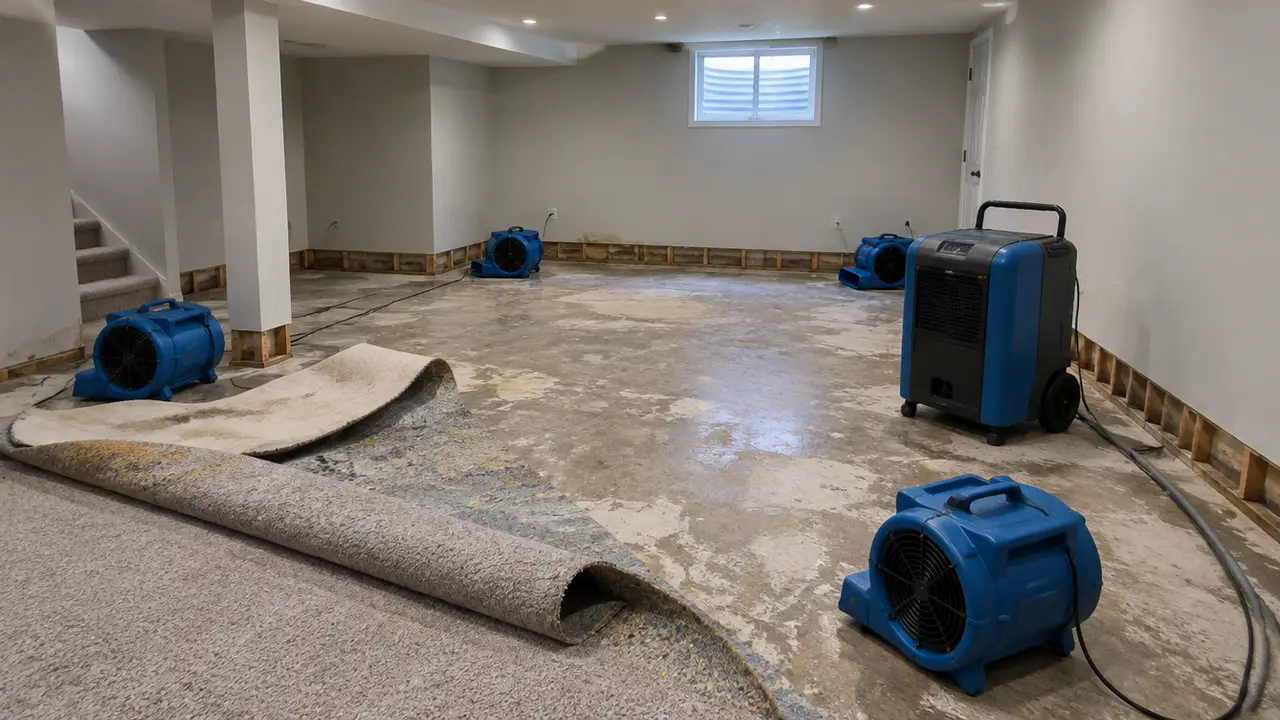
It deals with the water the pipe released: extraction, removal of wet materials, drying and monitoring, and often cleaning and odour control. Its work follows industry procedures such as the ANSI/IICRC S500 standard for professional water damage restoration, which describes the steps and precautions for drying homes and other buildings.
| Step | What it involves |
|---|---|
| Inspection and moisture mapping | Moisture meters and thermal imaging to find all the wet areas, including hidden ones |
| Water category assessment | Deciding whether the water is clean, grey or black, which drives what is kept |
| Extraction | Truck-mounted or portable units pull water from floors and carpet |
| Removal | Carpet pad, wet insulation and drywall cut above the wet line |
| Drying | Air movers and dehumidifiers placed and adjusted daily |
| Monitoring | Daily readings logged until materials reach the dry baseline |
| Cleaning | Surfaces cleaned; antimicrobial treatment where the water category calls for it |
Many restoration companies also offer rebuild work, such as drywall, flooring and painting. That can be convenient, but it is a separate scope you are free to price separately.
03 /When do you need one, and when do you need both?
It turns on how much water escaped, what it soaked and for how long. The plumber is needed for almost every burst; the restorer is needed when porous building materials are wet.
| Situation | Plumber | Restoration company | Others |
|---|---|---|---|
| Pinhole on an exposed pipe, a few litres on concrete | Yes | Usually not | None |
| Split in an unfinished basement, water on concrete only | Yes | Sometimes, for extraction | None |
| Water across finished flooring or carpet | Yes | Usually | Flooring installer for rebuild |
| Break inside a finished wall or ceiling | Yes | Usually | Drywall and paint trades |
| Water reached outlets, heaters or the panel | Yes | Usually | Licensed electrician before power is restored |
| Grey or sewage-contaminated water | Yes, if a drain is involved | Yes | Public health advice for sewage |
| Condo unit with damage below | Yes | Usually, coordinated by the building | Property manager |
04 /Who should you call first?
The plumber, unless the water is already off and the pipe is safely capped. Drying equipment cannot finish its job while water can still escape, and a restorer will usually want the source controlled before setting up. If you closed the main yourself, both calls can happen in the same hour.
- Close the main and make it safe
See the first-hour checklist and the electrical safety guide.
- Call a plumber
Describe the break, the pipe material if you know it, and whether it is exposed or inside a wall.
- Call your insurer or broker
Ask whether they want to send a restorer or whether you should book one.
- Book drying if materials are wet
Same day if possible; Health Canada ties a lower mould risk to drying within 48 hours.
- Line up the rebuild later
Drywall, flooring and paint come after readings show the structure is dry.
05 /How do you compare restoration estimates?
By checking that each one describes the same job: the same areas, the same water category, the same materials removed and the same monitoring. Price differences often come from different scopes, not different rates.
- Does the estimate name the water category and the affected rooms?
- Does it list what will be removed, with approximate areas?
- How many air movers and dehumidifiers, and for how many days before re-evaluation?
- Will you get daily moisture readings in writing?
- What is the dry standard, and who decides when drying is complete?
- Is rebuild included, and if so, is it priced separately so you can compare it?
- Who handles contents: moving, cleaning, storage or disposal lists?
Planning ranges for drying, removal and rebuild are in burst pipe repair cost. If a figure looks far outside them, ask what is driving it.
06 /What should you ask a plumber after a burst?
- What failed, and why? Will you put the cause in writing?
- Are there other weak spots on the same run, such as more splits or pinholes?
- What repair method and fittings will you use for this material?
- Does this need a permit here?
- Can you give me the failed section for my claim?
- Should the main shut-off be replaced while you are here?
- If the pipe is galvanized or poly-B, what would a repipe cost?
The Burst Pipe Repair Matcher prepares you for that conversation by showing the usual stop-gap and proper repair for your material and location.
07 /Does insurance let you choose the contractors?
Generally, yes. The Insurance Bureau of Canada notes that you can use a contractor or supplier of your choice, while the insurer estimates the cost of repairs and you are responsible for any difference. Insurers may also recommend contractors they work with, which can simplify billing.
HAUSE Home does not name or rank restoration companies or plumbers. If you would like help finding local trades for a repair or drying job, you can send a request. The records to keep for the claim are in documenting the claim.
08 /When do an electrician and a general contractor join in?
An electrician joins whenever water reached wiring, outlets, fixtures, baseboard heaters or the panel, and a general contractor or individual finishing trades join once the structure is dry. Neither is optional in those situations; they are simply later in the sequence than the plumber and the restorer.
| Trade | When they are needed | What to ask for |
|---|---|---|
| Licensed electrician | Any electrical device, box, fixture or panel got wet | A written assessment of what was replaced and that the system is safe to energise |
| Gas fitter or heating technician | A furnace, boiler or gas water heater sat in water | A check of burners, controls and venting before relighting |
| General contractor | Several rooms or trades need rebuilding | One schedule and one scope covering drywall, flooring, trim and paint |
| Individual finishing trades | A single room or a simple patch | Separate quotes that match the areas the restorer removed |
Keep every trade's invoice and written notes together with the plumber's cause and the restorer's drying log. Together they tell the whole story of the loss, which is what an adjuster needs to close the claim without extra visits.
09 /What does each trade cost?
As planning estimates for 2026, an emergency plumbing visit to repair an exposed break often plans at $350 to $900 including the call-out, while a one-room clean-water drying job plans at $1,500 to $4,000. Rebuild is separate. Larger losses, contaminated water and hidden breaks all push the numbers up.
FAQQuestions people ask
Do I need a restoration company for a small leak?
Not always. A small clean-water leak on hard surfaces caught within hours can often be handled with a wet vacuum, fans and a dehumidifier. Wet drywall, carpet, insulation or ceilings usually justify professional drying.
Can a plumber dry out my house after a burst pipe?
Plumbers fix the pipe. Some offer basic water removal, but monitored structural drying is usually the work of a water damage restoration company.
Who do I call first, a plumber or a water damage company?
Close the main shut-off, then call the plumber to control the source. Call the restorer the same day if walls, ceilings or floors are wet.
Does my insurance company choose the restoration company?
It may recommend one, but IBC notes you can use a contractor of your choice. Tell the insurer before work starts.
What should a water damage estimate include?
The affected areas, the water category, materials to be removed, equipment and days, the dry standard, daily readings and whether rebuild is included.