This glossary defines the words you meet after a pipe bursts in a Canadian home: valves and shut-offs, pipe materials such as copper, PEX, CPVC, galvanized steel and poly-B, repair fittings such as clamps and push-fit couplings, water damage drying terms such as air movers and dry standard, water categories, and insurance terms such as sudden and accidental, deductible and proof of loss.
- Valve and plumbing terms tell you what to close and what a plumber is proposing.
- Drying terms explain what the restoration crew is measuring and why equipment stays in place.
- Insurance terms such as sudden and accidental, gradual damage and proof of loss decide how a claim is assessed.
01 /How to use this glossary
Terms are grouped loosely by the order you meet them after a burst: shutting off the water, identifying and repairing the pipe, drying the house, and making the claim. Each definition is written to stand on its own. Tradespeople, adjusters and restorers do not always use the same word for the same thing, so common alternatives are noted where they matter.
Where a term links to a fuller explanation, follow the page named in the definition: the main shut-off guide for valves, repair by pipe material for fittings and materials, the drying guide for equipment and readings, and the insurance coverage guide for policy language.
02 /Which terms matter most in the first hour?
Five terms cover most first-hour decisions: main shut-off, fixture stop, service valve, stop-and-call hazard and water category. Knowing them lets you give a plumber, a utility or an insurer a clear description over the phone, which saves time and avoids a wasted trip.
| Term | Why it matters in the first hour |
|---|---|
| Main shut-off | Stops all water to the house at once |
| Fixture stop | Isolates one sink, toilet or appliance so the rest of the house keeps water |
| Service valve | The municipal valve outside; in Calgary, operated by the City through 311 |
| Stop-and-call hazard | Electricity near water, a sagging ceiling or sewage: act only after help arrives |
| Water category | Clean, grey or black: decides what can be kept |
A–ZTerms
- Additional living expenses (ALE)
- Insurance coverage for the increase in living costs, such as a hotel and meals, while a home cannot be occupied after a covered loss.
- Adjuster
- The person who examines an insurance claim, assesses the damage and explains what the policy covers.
- Air mover
- A high-velocity fan aimed across wet surfaces to speed evaporation during structural drying.
- Angle stop
- A small shut-off valve on the supply line under a sink or toilet; also called a fixture stop.
- Ball valve
- A quarter-turn valve with a lever handle and a drilled ball inside; closed when the lever sits across the pipe.
- Black water (Category 3)
- Water containing sewage or similar contamination, such as a sewer backup or a toilet overflow with feces. Porous materials it soaks are normally discarded.
- Burst
- A sudden failure of a pipe or fitting that releases water under pressure, such as a split, a blown-off fitting or a failed supply hose.
- Clean water (Category 1)
- Water from a sanitary source, such as a burst supply pipe, that has not become contaminated. It degrades with time and contact.
- Compression fitting
- A fitting that seals by squeezing a ring (ferrule) onto the pipe with a nut; common on fixture stops.
- Contents
- Your personal belongings, insured separately from the building in a home, condo or tenant policy.
- Copper pipe
- Rigid metal supply pipe joined by soldering, pressing or push-fit couplings. Freeze splits usually bulge along its length.
- CPVC
- Chlorinated polyvinyl chloride: rigid, cream-coloured plastic supply pipe rated for hot and cold water, joined by solvent welding with CPVC cement.
- Crimp ring
- A copper or steel ring compressed with a crimp tool to seal a PEX pipe onto a barbed fitting.
- Curb stop
- A common name for a municipal service valve buried near the property line, operated with a long key.
- Deductible
- The part of each covered loss you pay before insurance pays. Some policies set a separate or higher deductible for water damage.
- Dehumidifier
- A machine that removes moisture from air, either by condensing it on cold coils (refrigerant) or absorbing it (desiccant).
- Discharge coefficient
- A factor that reduces the theoretical flow through an opening to account for how water contracts as it exits; the Water Loss Timer uses 0.62.
- Dry standard
- The moisture reading of a material in an unaffected part of the house, used as the target for drying; also called the drying goal or baseline.
- Escape of water
- Insurance language for water released from plumbing, heating or appliances, as distinct from flood or sewer backup.
- Expansion tank
- A small pressurised tank on the cold supply to a water heater that absorbs water expansion in a closed system.
- Extraction
- Removing standing water and water held in carpet with a wet vacuum or extraction unit; the fastest step in drying.
- Fixture stop
- A shut-off valve serving one fixture or appliance, such as a toilet, sink, dishwasher or washer.
- Freeze split
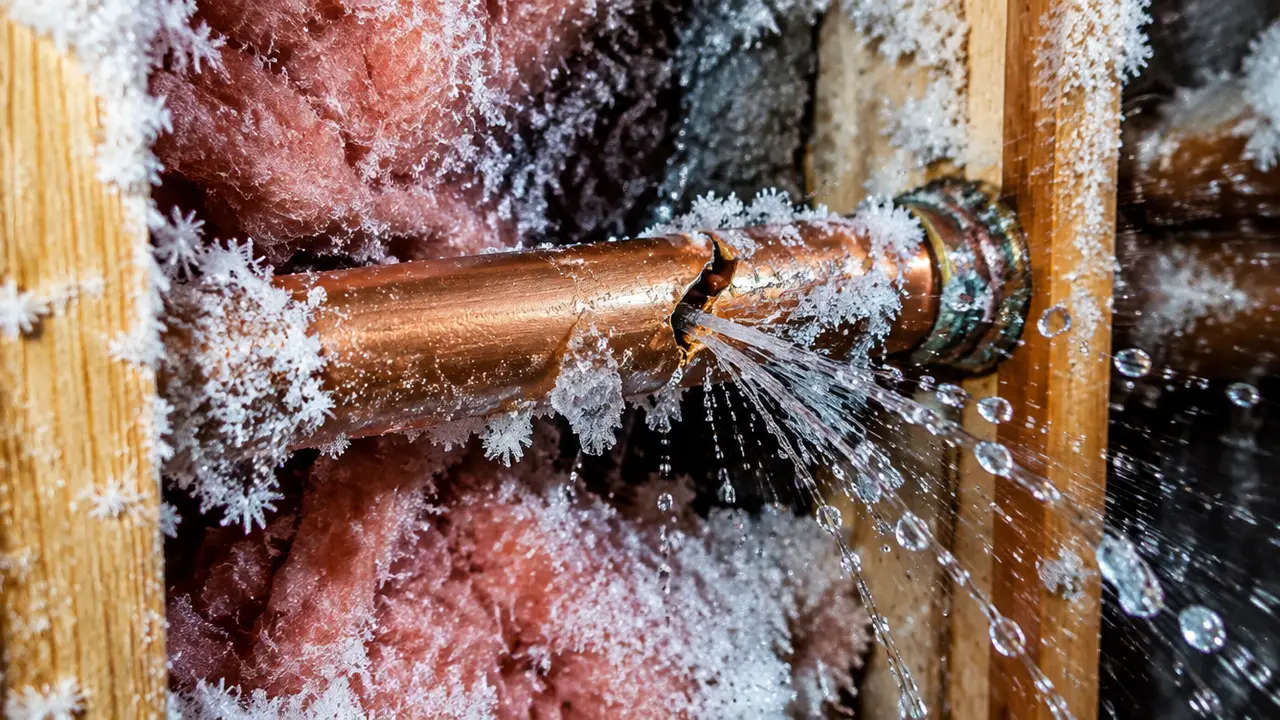
- A lengthwise rupture in a pipe caused by freezing; often accompanied by further splits along the same run.
- Galvanized steel pipe
- Zinc-coated steel supply pipe with threaded joints, found in older homes. It corrodes from the inside and is usually replaced rather than repaired long term.
- Gate valve
- A multi-turn valve with a round handle that raises or lowers a gate inside; common on older mains and prone to seizing.
- Gradual damage
- Damage that develops over time, such as seepage, rot or mould from a slow leak. Commonly excluded from home policies.
- Grey water (Category 2)
- Water with some contamination, such as appliance discharge or clean water that has sat or travelled through dirty areas.
- HEPA vacuum
- A vacuum with a high-efficiency particulate air filter, used before and after mould cleaning.
- Hygrometer
- An instrument that measures relative humidity in the air.
- Leak detection
- Methods used to find hidden leaks, including isolation and pressure testing, acoustic listening, thermal imaging and tracer gas.
- Loss assessment coverage
- Condo owner coverage that pays your share, up to a limit, of a large loss to common property that exceeds the corporation's coverage.
- Main shut-off
- The valve that stops all water to the house, usually where the service line enters the basement near the meter.
- Moisture map
- A drawing or marked-up photo showing where materials read wet, produced during inspection and updated during drying.
- Moisture meter
- A pin or pinless instrument that measures moisture in building materials such as drywall, wood and subfloor.
- Mould
- Fungal growth on damp materials. Health Canada says a house and furnishings are less likely to grow mould if dried within 48 hours.
- N95 respirator
- A disposable respirator that filters airborne particles; recommended for removing wet drywall and insulation and for mould cleanup.
- Named perils
- A policy type that covers only the causes of loss it lists; escape of water must be listed to be covered.
- Orifice flow
- The flow of water through an opening under pressure, estimated from the opening's area and the pressure difference.
- PEX
- Cross-linked polyethylene: flexible plastic supply pipe joined with crimp, clamp or expansion fittings; more tolerant of freezing than rigid pipe but still able to split.
- Poly-B
- Polybutylene: flexible grey plastic supply pipe found in some older homes. Many insurers and buyers treat it as a known risk.
- Press fitting
- A fitting with an internal seal that a powered tool crimps onto copper or other pipe, avoiding a flame.
- Pressure-reducing valve (PRV)
- A valve on the main line that lowers incoming water pressure to a set level to protect plumbing and fixtures.
- Proof of loss
- A signed statement of what was damaged or lost and its value; IBC notes it typically must be returned within 30 days.
- Push-fit coupling
- A fitting that grips and seals a pipe with an internal ring when the pipe is pushed in; used as a stop-gap and, where rated and allowed, as a permanent repair.
- PVC
- Polyvinyl chloride: rigid plastic pipe for cold water only in supply use; joined with PVC cement.
- Relative humidity (RH)
- The moisture in air as a percentage of what it could hold at that temperature. Health Canada recommends 30% to 50% indoors.
- Repair clamp
- A bolted metal band with a rubber pad that closes over a split or pinhole as a temporary repair.
- Repipe
- Replacing most or all of a home's supply piping, usually after repeated leaks or when the material is failing.
- Reroute
- Running a new pipe along a different path, such as through walls instead of under a slab, and abandoning the old section.
- Service line
- The pipe that brings water from the municipal main to the house; ownership usually splits at the property line.
- Service valve
- The municipal valve on the service line outside the house. In Calgary, service valves are owned and operated by the City.
- Sewer backup
- Water and sewage flowing back into a home through drains; usually an optional add-on coverage, separate from escape of water.
- Slab leak
- A leak in a pipe running under a concrete floor, found with leak detection and fixed by breaking the slab or rerouting.
- Solder
- A metal alloy melted into a copper joint with a torch to seal it; the pipe must be drained first.
- Solvent weld
- A plastic pipe joint made with a cement that softens and fuses the pipe and fitting; used on CPVC and PVC.
- Stop-gap
- A temporary repair that holds pressure until a permanent repair is made, such as a clamp or rated coupling.
- Sudden and accidental
- Insurance language for a loss that happens at once and unexpectedly, such as a pipe splitting; the opposite of gradual damage.
- Supply limit
- The most water the service line, meter and plumbing can deliver to an open break; the Water Loss Timer's cap, defaulting to 45 L a minute.
- Tenant insurance
- A policy for renters that covers belongings, personal liability and additional living expenses after a covered loss.
- Thermal imaging
- A camera that shows surface temperatures; cool patches from evaporation can reveal wet areas behind walls.
- Water category
- The contamination level of escaped water: clean (1), grey (2) or black (3). It decides what can be dried and kept.
- Water hammer
- A banging shock in pipes when a valve closes quickly; it strains joints and can loosen supports.