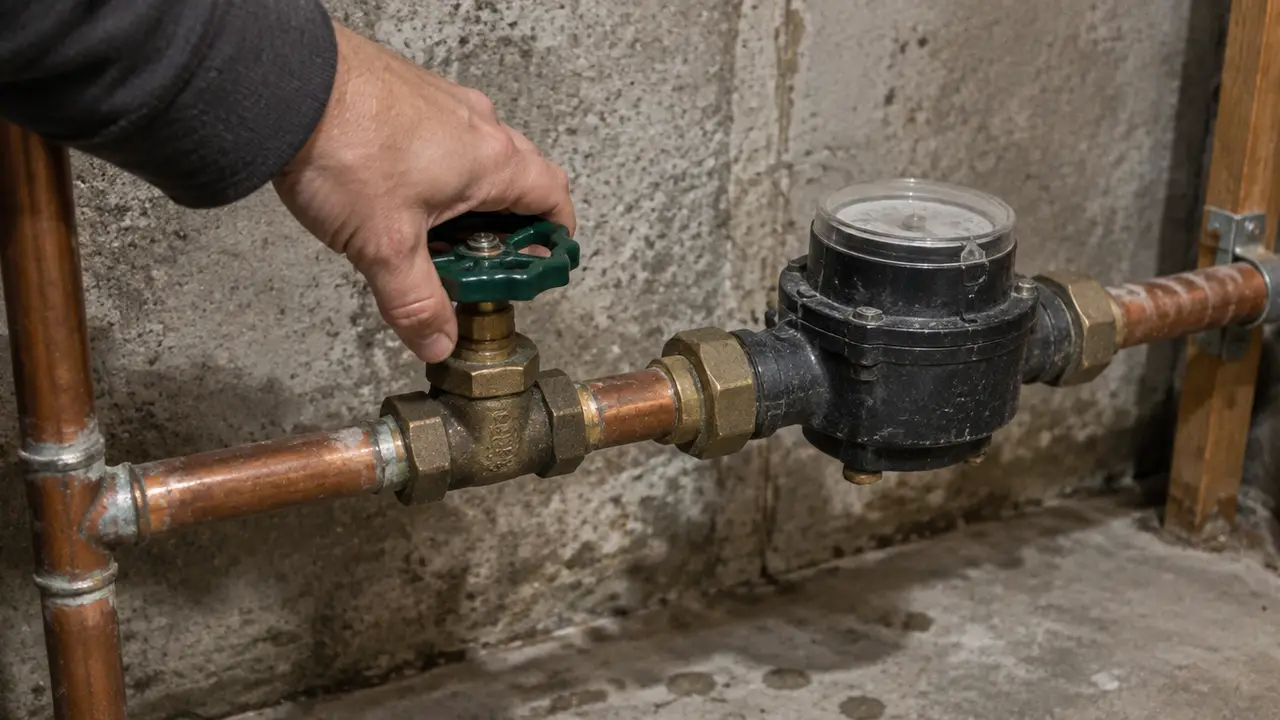
The main water shut-off is usually where the water service enters the house, in the basement or utility room near the floor and often beside the water meter. A round handle turns clockwise until it stops; a lever turns a quarter turn until it sits across the pipe. If it will not close, call a plumber and your municipality, which controls the outdoor service valve.
- Find and label the main shut-off before you need it; searching during a burst costs hundreds of litres.
- Gate valves turn many times clockwise; ball valves close with a quarter turn of the lever.
- An old valve that will not turn or will not seal is a plumbing repair, not something to force with a long wrench.
- The outdoor service valve usually belongs to the municipality; in Calgary, call 311 rather than operating it yourself.
- Condos and townhouses often have a unit valve plus a building valve that only management can reach.
01 /Where is the main water shut-off in a house?
It is almost always where the water service pipe comes through the foundation or up through the basement floor. From there the line runs to the water meter, if the house is metered, and on to the rest of the plumbing. The main shut-off sits on that pipe, usually within arm's reach of the meter and close to the floor.
The City of Calgary describes the internal main shut-off as located where the water line enters the home and typically close to the water tank, usually in the basement near the floor. That pattern holds in most Canadian houses built with basements, because the service line arrives below the frost line and rises inside the foundation wall.
| Home | Most likely location | Also check |
|---|---|---|
| Detached house with basement | Front basement wall or utility room, near the meter | Behind a removable panel in a finished basement |
| House on a slab or crawlspace | Mechanical room, garage wall or near the water heater | An access hatch in the crawlspace |
| Townhouse | Mechanical room or under the stairs | A shared valve in a common utility room |
| Apartment or condo unit | Under the kitchen sink, behind a bath or laundry access panel, or in the in-suite mechanical closet | Corridor or riser valves controlled by management |
| Cottage or seasonal home | Where the supply enters from the well or municipal line | The pump or pressure tank area |
Finished basements hide valves behind drywall, under stairs or inside storage rooms. If you cannot find yours, follow the cold water pipe back from the water heater or the laundry tap toward the front wall of the house. Once you find it, put a bright tag on it and make sure every adult in the home has seen it.
02 /How do you close a gate valve versus a ball valve?
A gate valve has a round wheel handle and closes by turning clockwise several times; a ball valve has a lever and closes with a quarter turn. Many older Canadian houses still have gate or globe valves on the main, while newer homes and renovations tend to use ball valves.
Turn steadily with your hand. If the stem drips after you close a gate valve, the packing nut around the stem is loose or worn; a gentle snug with a wrench often stops it. If the handle spins without resistance, the stem has broken from the gate inside and the valve is not closing at all.
03 /What if the main shut-off will not turn or will not seal?
Do not lever it with a pipe extension; call a plumber and contact your municipality. An old gate valve can snap its stem or crack its body under force, which turns a leak into a second break at the one point where you most need control.
- Try steady hand pressure
Grip the handle close to the stem and turn slowly. A few back-and-forth movements can free a stiff stem.
- Use local shut-offs meanwhile
If the break is at a fixture, close the stop under that sink, toilet or appliance. If it is on the hot side, close the cold supply valve on top of the water heater.
- Reduce the damage
Open the lowest taps to lower the pressure at the break, collect water in buckets and move belongings.
- Call the municipality
The outdoor service valve can shut off the whole house. In Calgary, the City owns and operates it; call 311 and explain that the house is flooding.
- Call a plumber
Ask for the main valve to be replaced with a quarter-turn ball valve once the break is repaired.
04 /Who controls the outdoor service valve?
In most Canadian cities the municipality controls it, and the owner is responsible for the pipe on the house side of it. Calgary spells this out: service valves are owned and operated by The City, and the lines running from the service valve to the building are the owner's responsibility.
Calgary asks residents to call 311 or submit an online request to have crews investigate valve problems, and notes that fees can apply when the City shuts off water at the service valve for owner work under its Water Interruptions and Disconnections service. If your house is flooding, say so, because an active flood is triaged differently from a planned shut-off. Other municipalities organise this differently; check your city's water utility page or call its service line.
The split of ownership matters again later, when a break is outside the house. The slab and yard guide covers who pays for a leak on the service line, and Calgary burst pipe help sets out the City's side for Calgary homes.
05 /How do you shut off water in a condo or apartment?
Close the unit's own valve if it has one, and call building management or security at once. Many units have a shut-off for the whole suite, often in a mechanical closet, under the kitchen sink, or behind an access panel near the tub or laundry. Some older buildings have only fixture stops, with the real control on a riser that serves several floors.
- Know whether your suite has its own valve before anything happens; ask management to show you.
- Close the fixture stop if the leak is at a toilet, dishwasher, washing machine or sink supply.
- Warn the units below you; water travels through ceilings and service chases quickly.
- Photograph the source and the damage, because the condominium corporation and your own insurer may both need the record.
Condo bylaws and insurance decide who pays for what afterward. Tenants, landlords and condos explains the usual split.
06 /Which other shut-offs should you know?
The fixture stops under sinks and toilets, the cold supply valve at the water heater, and the washing machine valves. Each one lets you isolate a single failure and keep the rest of the house running, which matters when a plumber cannot come for a day.
| Valve | What it isolates | Tip |
|---|---|---|
| Main shut-off | The whole house | Tag it and test it once a year |
| Water heater cold supply | The tank and every hot tap | Closing it stops a leaking tank refilling |
| Fixture stops (angle stops) | One sink, toilet or dishwasher | Old multi-turn stops often leak when first turned; have spares |
| Washing machine valves | The washer hoses | Close them when you go away |
| Exterior tap isolation valve | An outdoor faucet | Found inside, on the line to the hose bib |
| Irrigation or sprinkler valve | The lawn system | Often near the main shut-off |
The shut-off for an outdoor tap is also the valve you close before winter, which is prevention territory covered in depth by BurstPipes.ca.
07 /How do you test the main shut-off before an emergency?
Close it slowly, check that a tap runs dry, and open it again, once a year. A valve that is never exercised is the one most likely to seize, and it is better to find that out on a quiet afternoon with a plumber booked than at 2 a.m. with water pouring through a ceiling.
- Choose a time when no one needs water for half an hour.
- Close the main valve steadily by hand.
- Open a tap on the lowest floor. It should slow to a trickle and stop within a minute or two.
- Reopen the valve slowly to avoid a pressure surge, then run each tap briefly to clear air.
- If the valve was stiff, wept at the stem, or did not stop the flow, book a plumber to replace it with a full-port ball valve.
Replacing a failed main valve is a common add-on when a plumber is already on site for a burst; it is listed with other line items in burst pipe repair cost. Automatic shut-off valves, which close the main on their own when a sensor gets wet, are covered in preventing another burst pipe.
FAQQuestions people ask
How do I know if my main water valve is fully closed?
A gate valve will not turn further clockwise, and a ball valve lever sits across the pipe. Open the lowest tap in the house: it should slow to a trickle and stop within a minute or two.
Why is water still running after I closed the main shut-off?
The pipes are draining, the old valve is not sealing, or the break is on the street side of the valve. If flow continues after a couple of minutes, call a plumber and your municipality.
Can I turn off the water valve outside my house myself?
Usually not. The outdoor service valve generally belongs to the municipality and needs a special key. In Calgary, the City owns and operates it, so call 311.
Where is the water shut-off in an apartment?
Check under the kitchen sink, behind the tub or laundry access panel, and in the in-suite mechanical closet. If you cannot find a suite valve, close the fixture stop and call building management right away.
Should I replace an old gate valve on my main water line?
If it is stiff, weeps at the stem or does not stop the flow completely, yes. A plumber can usually swap it for a quarter-turn ball valve during another repair.