A burst pipe is repaired properly by cutting out the damaged length and joining new pipe of the same material with fittings rated for it: soldered, pressed or push-fit joints on copper; the house's existing crimp, clamp or expansion system on PEX; solvent-welded joints with CPVC cement on CPVC. Galvanized steel and poly-B can be patched with approved fittings, but a burst is usually the time to price a repipe.
- Identify the pipe before buying anything; the fitting must be rated for that exact material and size.
- The permanent fix replaces the damaged length; clamps and couplings are stop-gaps.
- Freeze splits often come in more than one place along the same run, so the whole exposed length gets checked.
- Galvanized steel corrodes from the inside and poly-B is widely treated as a known risk, so both usually lead to a repipe discussion.
- Pressure-test the repair before walls or ceilings are closed.
01 /How do you tell which pipe you have?
By colour, markings and how the joints are made. Most pipe is printed with its material and rating along its length, so look for text on the pipe before anything else. Where there is none, these clues usually settle it.
| Material | What it looks like | How joints look | Common era |
|---|---|---|---|
| Copper | Rigid, orange-brown, green where old or tarnished | Soldered fittings with a silver ring of solder, or pressed or push-fit fittings | Most eras; dominant for decades |
| PEX | Flexible plastic, often red, blue or white, sometimes grey | Metal crimp or clamp rings, or flared expansion fittings | Common in newer homes and renovations |
| CPVC | Rigid, cream or pale yellow plastic | Glued (solvent-welded) fittings | Used in some homes and renovations |
| PVC | Rigid white or grey plastic | Glued fittings | Cold-water lines such as some services and irrigation only |
| Galvanized steel | Grey metal, threaded | Threaded fittings, often corroded at the joints | Older homes, often partly replaced |
| Poly-B (polybutylene) | Flexible grey plastic, sometimes other colours | Plastic or metal crimp-ring fittings | Generally late-1970s to 1990s homes; confirm by inspection |
If you are not sure, photograph the pipe and any printing and show the plumber. The difference between CPVC and PVC, or poly-B and grey PEX, matters for both the fitting and your insurance. Fitting names such as crimp ring, press fitting and solvent weld are defined in the glossary.
02 /How is burst copper pipe repaired?
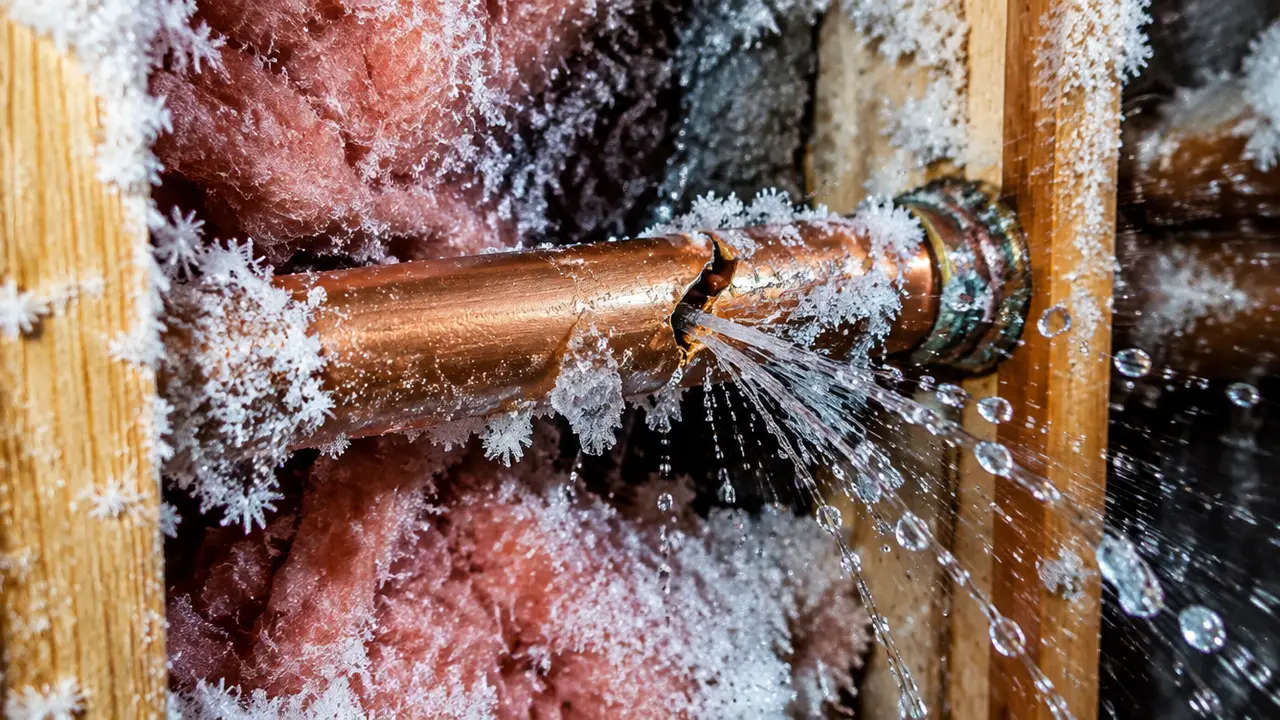
The damaged section is cut out and a new piece of copper is joined in, by soldering, by pressing, or with push-fit couplings rated for copper. A split from freezing typically runs lengthwise and bulges the pipe, so the cut goes past the bulge on both sides into round, undamaged pipe.
- Soldered joints need the line fully drained, since water in the pipe stops it heating; a plumber manages the fire risk near framing with a heat shield.
- Press fittings use a tool to crimp a fitting with an internal seal onto the pipe; no flame, which suits tight or finished spaces.
- Push-fit couplings grip and seal with an internal ring; rated versions are used for permanent repairs in many jurisdictions, but check whether they may be concealed in a wall where you live.
- Repair clamps wrapped around a split are the stop-gap, not the repair.
Pinholes in copper deserve a closer look. A single pinhole may be a local defect, but several along a run can point to wider wear, and the plumber should judge the rest of the line before patching one hole at a time.
03 /How is burst PEX repaired?
With a new PEX section joined using the same fitting system already in the house: crimp rings, stainless clamp rings or expansion fittings. PEX is more forgiving of freezing than rigid pipe because it can stretch, but it still splits, and its fittings can crack or pull out.
- Match the system: expansion fittings need expansion-rated PEX and the right tool, and crimp and clamp rings need their own tools and gauges.
- A push-fit coupling rated for PEX is the usual stop-gap and, where allowed, can be a permanent repair.
- Look for kinks, crushed sections and fittings that have pulled apart, not only splits.
- Keep repairs out of sunlight and away from heat sources such as recessed lights and flues.
04 /How are CPVC and PVC repaired?
By cutting out the damage and solvent-welding in a new section with the correct cement and fittings: CPVC cement for CPVC, PVC cement for PVC. The two are not interchangeable. CPVC is rated for hot and cold water; PVC is for cold water only and should not appear on a hot line.
- Solvent-welded joints need cure time before the line is repressurised; the cement's label gives it by pipe size and temperature.
- Older CPVC can be brittle, so a gentle hand is needed near the repair; cracking at the next fitting is a common follow-on failure.
- A repair clamp or a push-fit coupling rated for CPVC can hold as a stop-gap on exposed pipe.
05 /What about galvanized steel and poly-B?
Both are repairable in the short term and are usually candidates for replacement. Galvanized steel corrodes from the inside, narrowing the bore and weakening threads, so a burst often means the rest of the line is close behind; the practical repair is to replace the damaged run and plan to repipe. Poly-B is repaired with fittings approved for poly-B, and many insurers and home buyers treat it as a known risk, so the repair usually comes with quotes to repipe.
| Material | Stop-gap | Proper repair | Longer-term |
|---|---|---|---|
| Galvanized steel | A repair clamp | Replace the damaged run | Plan a repipe |
| Poly-B | A fitting approved for poly-B | Repair with approved poly-B fittings | Get quotes to repipe |
06 /What are the repair options side by side?
This table matches the patterns the Burst Pipe Repair Matcher uses for each material.
| Material | Stop-gap | Proper repair |
|---|---|---|
| Copper | Repair clamp, or a push-fit coupling rated for copper | Cut out the damage and join new copper by soldering, pressing or push-fit couplings |
| PEX | A push-fit coupling rated for PEX | New PEX section with the crimp, clamp or expansion fittings already in the house |
| CPVC | A repair clamp, or a push-fit coupling rated for CPVC | New CPVC section solvent-welded with CPVC cement and fittings |
| PVC (cold water) | A repair clamp | New PVC section solvent-welded; PVC is for cold water only |
| Galvanized steel | A repair clamp | Replace the damaged run and plan to repipe |
| Poly-B | A fitting approved for poly-B | Approved poly-B fittings, plus quotes to repipe |
Stop-gaps are covered on their own in temporary burst pipe fixes, including the ones that do not work.
07 /Does the location change the repair?
Yes, more than the material does in many cases. An exposed pipe in an unfinished basement is a short job. The same pipe inside a finished wall or ceiling needs an opening, drying and a mould check. Under a slab or in the yard, the leak has to be found first, and rerouting is often compared with breaking concrete.
| Location | Added work | Who usually does it |
|---|---|---|
| Exposed and easy to reach | Little; drain, cut, join, test | Plumber; a handy owner may fit a rated stop-gap on copper, PEX or CPVC |
| Inside a finished wall or ceiling | Opening, removing wet insulation, drying, mould check, patching | Plumber, plus drying and drywall trades |
| Under a slab or in the ground | Leak detection, excavation or reroute, concrete or landscape restoration | Plumber, often with excavation |
See burst pipe in a wall or ceiling and burst pipe under a slab or in the yard for those jobs in detail.
08 /Does a burst pipe repair need a permit or inspection?
Usually not for a like-for-like leak repair, but it can when lines are replaced or the system is altered. The National Plumbing Code of Canada covers the extension, alteration, renewal and repair of existing plumbing systems as well as new ones, and each province adopts and administers its own version. Calgary, for example, lists repairing a leak in a water distribution system among work that does not need a plumbing permit, but requires one for replacing water and sewer lines.
A repipe after a galvanized or poly-B burst is normally permitted work. Ask the plumber to confirm with the municipality, and keep the permit and final inspection with the claim file. Pricing for spot repairs and repipes is in burst pipe repair cost.
FAQQuestions people ask
What is the best way to fix a burst copper pipe?
Cut out the damaged section and join new copper by soldering, pressing or rated push-fit couplings. Check the rest of the run for more splits if it froze.
Can you repair a burst PEX pipe with a push-fit coupling?
A push-fit coupling rated for PEX is the common stop-gap and, where allowed, a permanent fix. Otherwise, use the crimp, clamp or expansion system already in the house.
Can CPVC and PVC be glued together?
Do not treat them as interchangeable. CPVC takes CPVC cement and fittings; PVC takes PVC cement and is for cold water only. Ask a plumber before joining different plastics.
Should I replace poly-B after a burst?
Get quotes to repipe. Poly-B can be repaired with approved fittings, but many insurers and buyers treat it as a known risk, so a burst is a natural time to plan replacement.
Can a plumber fix just the burst section of an old pipe?
Usually, yes, as a repair. Whether it is wise depends on the rest of the line: pinholes elsewhere, corroded galvanized threads or poly-B fittings point toward a wider replacement.