The temporary fixes that hold on a burst supply pipe are a bolted repair clamp over the split and a push-fit coupling rated for the pipe after the damaged length is cut out. Self-fusing silicone tape and epoxy putty can slow a pinhole on a drained line. Duct tape, glue on a wet pipe and anything on a split still under pressure fail. Every stop-gap waits for a proper repair.
- A stop-gap buys time to get water back on; it is not the repair, and you should watch it until the plumber comes.
- Shut off and drain the line before fitting anything; almost nothing seals against a spray.
- Repair clamps and rated push-fit couplings are the strongest owner-fitted options on exposed copper, PEX and CPVC.
- Tapes and putties suit pinholes and weeping joints, not splits or blown fittings.
- Close the main again at night and when you leave the house until the permanent repair is done.
01 /When is a temporary fix worth trying?
When the break is on an exposed pipe you can reach safely, the water is off, and you need a working supply for a few hours or a night before a plumber can come. If the break is inside a wall, under a slab, on galvanized or poly-B pipe, or anywhere you would have to reach past wiring, leave the main closed and wait.
| Situation | Stop-gap reasonable? | Why |
|---|---|---|
| Exposed copper, PEX or CPVC in an unfinished basement | Often yes | Easy access, rated stop-gap fittings exist |
| Pinhole or weeping joint on exposed pipe | Yes, as a slow-down | Low flow; tape or putty can hold at low stress |
| Split or blown fitting inside a finished wall | No | The wall must be opened and dried anyway |
| Break under a slab or in the yard | No | Needs detection and excavation |
| Galvanized steel or poly-B | Only a clamp, with care | Old pipe can crack further; ask your insurer before scoping |
| Any break near electrical equipment | No | Safety first; see the electrical guide |
If you only need part of the house back, closing a fixture stop or the water heater's cold supply may isolate the break without any patch. The main shut-off guide lists the valves worth knowing.
02 /Which temporary fixes actually hold?
Mechanical ones: a bolted clamp with a rubber pad over the damage, or a rated coupling that replaces the damaged length. They hold because they grip the pipe, not because something sticks to it.
| Fix | Best for | Holds | Limits |
|---|---|---|---|
| Bolted repair clamp with rubber pad | Splits and pinholes on straight copper, CPVC, PVC or steel pipe | Well, at normal pressure | Must match the pipe's outside diameter; not over fittings or bends |
| Push-fit coupling rated for the pipe | A cut-out section of copper, PEX or CPVC | Well, and some are rated as permanent | Pipe must be cut square, deburred and marked for insertion depth |
| Self-fusing silicone repair tape | Pinholes and small cracks | Moderately, on a drained and dry pipe | Stretched and wrapped tightly; weak on splits |
| Epoxy pipe putty | Pinholes and weeping joints | Moderately, once cured | Needs a clean, dry surface and cure time before pressure |
| Rubber sheet and hose clamps | An emergency slow-down on a pinhole or small crack | Poorly to moderately | Improvised; watch it constantly |
03 /How do you fit a repair clamp?
Drain the line, centre the clamp's rubber pad over the damage, and tighten the bolts evenly. A clamp spreads pressure over the pad so the rubber seals against the pipe wall.
- Shut off and drain
Close the main and open the lowest tap so the pipe is empty and not under pressure.
- Measure the pipe
Clamps are sized by the pipe's outside diameter. A ½-inch copper line and a ½-inch PEX line are not the same outside size.
- Clean the area
Wipe off water, corrosion and burrs so the pad sits flat on sound pipe on both sides of the damage.
- Centre and tighten
Place the pad over the split with margin on both ends, close the clamp and tighten the bolts alternately until snug.
- Pressurise slowly
Open the main a little at a time and watch the clamp for drips for several minutes before opening fully.
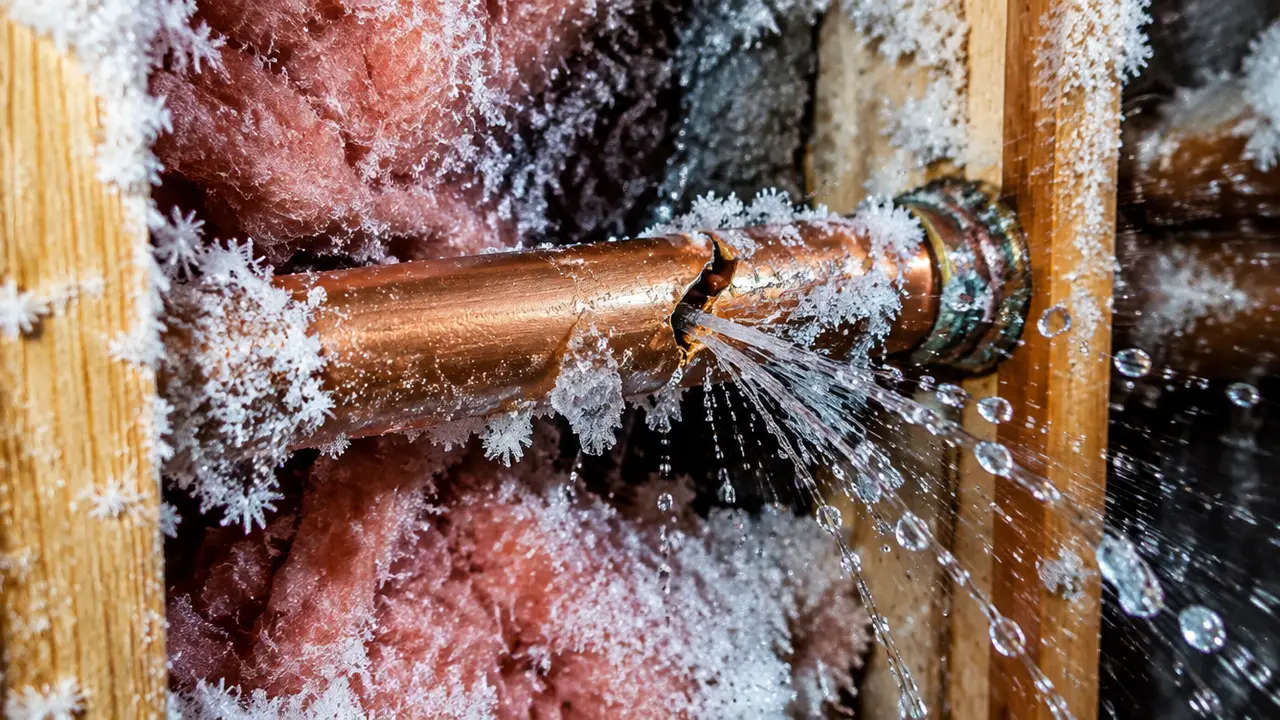
If the split runs past the end of the clamp, or there is a second split nearby, the clamp will not seal. Freeze damage often includes more than one split along a run, so check the whole exposed length before you trust the patch.
04 /How do you fit a push-fit coupling?
Cut out the damaged length with a square cut, deburr the pipe ends, mark the insertion depth and push each end fully home. For a longer damaged section, a short piece of new pipe goes between two couplings.
- Drain the line and cut out the damaged section with a tube cutter for copper or a plastic pipe cutter for PEX and CPVC; hacksaws leave ragged ends that can damage the seal.
- Deburr and clean the cut ends inside and out.
- Check the fitting is rated for the pipe material and size; for PEX, insert the stiffener if the fitting requires one.
- Mark the insertion depth on each pipe end using the fitting's guide.
- Push each end in until it reaches the mark, then tug to confirm it has locked.
- Pressurise slowly and watch for drips.
Some push-fit couplings are rated for permanent use and for concealment. Whether that is acceptable in your jurisdiction and for your insurer is a question for your plumber; treat an owner-fitted coupling as temporary until a plumber has looked at it.
05 /Which temporary fixes fail?
Anything that relies on adhesion to a wet or pressurised pipe, and anything that has to hold a split open against full line pressure. These are the ones that tend to let go overnight.
| Fix | Why it fails |
|---|---|
| Duct tape or electrical tape on a split | Adhesive lets go under pressure and when wet; the tape stretches and peels |
| Glue or sealant on a wet or leaking pipe | Nothing bonds to a wet surface; water pushes through before it sets |
| Epoxy putty on a pipe that is still spraying | Cannot cure under flowing water |
| Plastic cement on the wrong plastic | PVC and CPVC cements are not interchangeable; the joint never welds properly |
| Any fitting not rated for the pipe | Sizes and seals differ between materials, especially copper and PEX |
| Heating a frozen section with an open flame | Starts fires in cavities and can burst the pipe as steam forms |
06 /How long can a temporary fix stay in place?
Until the plumber arrives, and not as a long-term plan. A clamp or rated coupling on an exposed pipe may hold for a good while, but freeze-damaged pipe near the repair is often weakened, and tapes and putties degrade with heat, vibration and pressure swings. The honest answer is days, not seasons.
There is also a claim reason to replace it promptly. A patch that fails weeks later can produce a second loss that looks like neglect, which is the kind of gradual or unrepaired damage insurers commonly exclude. The insurance coverage guide explains why.
07 /What does the proper repair look like after the stop-gap?
The plumber removes the patch, cuts back to sound pipe, and joins a new section with fittings rated for the material, then pressure-tests it. For copper, that is a soldered, pressed or rated push-fit joint; for PEX, the house's crimp, clamp or expansion system; for CPVC, a solvent-welded section. Galvanized and poly-B usually lead to a repipe conversation. In Calgary, fixing a leak is on the City's list of plumbing work that needs no permit, but once the job becomes replacing water lines, a permit applies; check your own municipality's list.
The Burst Pipe Repair Matcher gives the stop-gap and proper repair for your material, damage and location, and only suggests an owner-fitted stop-gap for exposed copper, PEX or CPVC. The methods are explained in repair by pipe material, and the costs in burst pipe repair cost.
FAQQuestions people ask
Does pipe repair tape work on a burst pipe?
Self-fusing silicone tape can slow a pinhole or small crack on a drained, dry pipe. It is not reliable on a split or a blown fitting under full pressure.
Can I use a push-fit coupling to fix a burst pipe myself?
On exposed copper, PEX or CPVC, a rated push-fit coupling is a common owner stop-gap. Cut square, deburr, mark the depth and push fully home, then have a plumber check it.
Will epoxy putty stop a leaking pipe?
On a clean, dry pinhole or weeping joint, it can hold once cured. It will not set on a pipe that is still spraying or dripping.
Is duct tape a good temporary fix for a burst pipe?
No. The adhesive lets go when wet and under pressure. Use a repair clamp or a rated coupling instead, or leave the water off.
Can I leave a pipe repair clamp on permanently?
Treat it as temporary. Freeze-damaged pipe near the clamp is often weakened, and a failed patch can create a second claim that looks like neglect.